What a press trip actually delivers
The real work behind a Condé Nast Traveller placement.
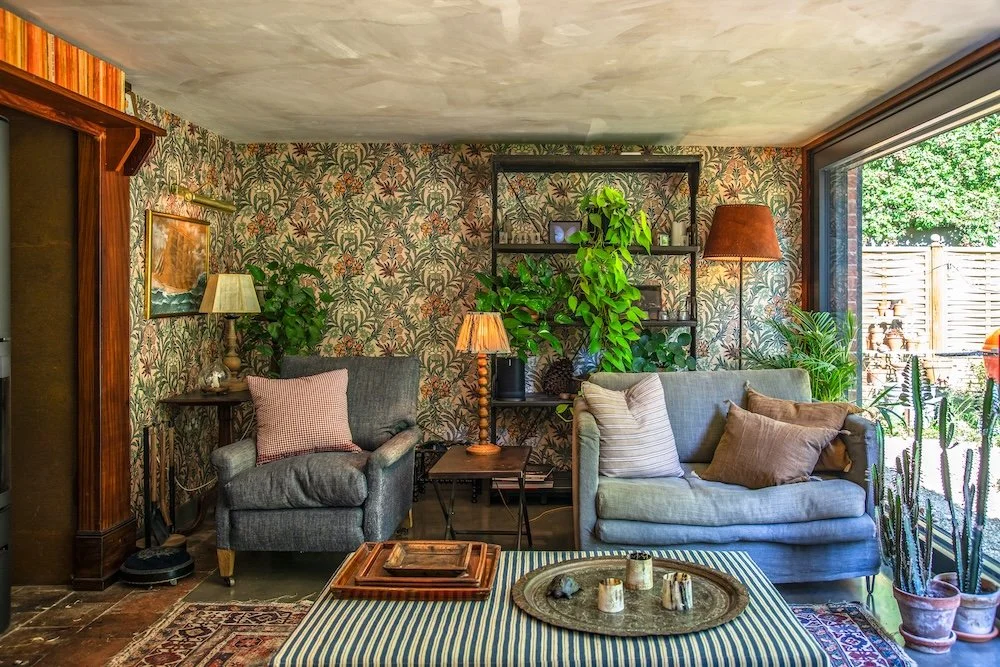
Riverbank Norfolk by India Hobson
Riverbank is a chalk-stream cottage just south of Holt, in North Norfolk. A 1700s brickworkers' cottage, renovated by Ana Perez and Alan Flett over a number of years. The property is bursting with personal details. The horseshoe over the front door belonged to Ana's grandmother and hangs downwards in the Spanish tradition of letting luck spill into the home. The lounge is layered in Robert Kime "Iris" wallpaper; the wood-panelled kitchen is painted in Benjamin Moore Tuscany Green. One of the bedrooms is lined in Soane Britain "Dianthus Chintz." There are entomology cases on the kitchen shelves and a Peruvian Blue-black bird-eating spider that Ianthe Butt, writing for Condé Nast Traveller this month, observes "mightn't be to everyone's taste."
I have read the entry several times already. It is two paragraphs long. It names six designers, three rooms, two adjacent properties, and the family story behind the front door. It reads like a House & Garden property tour written by someone who came, stayed, and took time over it.
This is exactly what we worked toward for Riverbank Norfolk. It is also what many properties pitching for editorial coverage will never see, even when they secure that hard-earned press trip. The gap between those outcomes is not luck, and it is not just the property. It is the work that goes on behind the trip.
What a press trip actually is…
A press trip, stripped to its mechanics, is a journalist visiting a property with the expectation of writing about it. That is the easy description.
Here’s the fuller description: a press trip is a transaction of editorial trust. The journalist is committing two to three working days, their travel, and a slot in their schedule. In return, they expect access to a property that will genuinely earn the column inches their editor is being asked to commit. They are not interested in being walked around a live media kit. They want to experience the things that will turn into the sentences they have to write — the family stories, the materials, the named designers, the texture of the light on a Tuesday in March.
A press trip that produces a paragraph is one where the journalist arrived, was shown a property, and left with enough for a polite sentence. A press trip that produces more in Condé Nast Traveller is one where the work behind the visit has lined up — the right journalist matched to the right property, the brief brought to life from the owner to the writer with thoughtful details that will make the piece, and the access calibrated so the journalist sees what they need without being managed.
For Riverbank, this meant Ianthe Butt. Ianthe writes across Condé Nast Traveller, The Times Travel, and Wallpaper* — three outlets where the detail-led, design-conscious tour-of-the-property format lives most fluently. She is the kind of writer who notices a horseshoe pointing downwards and recognises what it is. The perfect match.
Why most properties never see this kind of write-up
There are two reasons:
The first is that the press trip industry has drifted over the past decade toward something more transactional. Properties offer hosted stays in exchange for guaranteed coverage. The journalist visits briefly to fulfil a request, files a paragraph, the property gets the coverage, the journalist gets the stay. The economics are questionable and the output is usually perfectly fine.
The second is that even when a press trip is genuinely based on earned recognition, the journalist will only write properly about the property if the visit has been set up to give them what they need. That set-up is the part founders rarely see. It is the relationship that allows you to contact a journalist directly rather than emailing a desk. It is the years of judgement that allow you to call this property is right for this writer and not that one. It is the discipline of highlighting the right details — the family story, the inglenook, the wallpaper provenance — rather than every detail. It is also the willingness, when the visit is happening, to stay out of the way and let the writer do their job. And importantly, trust in the writer and the editorial process. In this case, the commission was for ‘whimsical cottages’, but as the feature evolved, the ‘Best of Holiday Homes’ landed.
This work is invisible from the outside. From a founder's perspective, all that is visible is the journalist arriving for free and the coverage appearing some weeks later. The judgement that produced the match, the relationships that allowed it, and the briefing that shaped what the journalist noticed — all of that sits underneath the result, where it cannot be inspected.
It is the part of PR that is most worth paying for, and the part that founders almost never know they are paying for. It is also the part that London consumer-PR agencies operating from media lists rather than relationships have been quietly losing for years. A list will tell you which journalist covers holiday lets. It will not tell you which journalist will respond to a chalk stream, a Robert Kime wallpaper, and a horseshoe that was originally Ana's grandmother's.
What the placement keeps doing
The other thing worth saying about this kind of coverage is that it does not stop working when the issue cycles out.
A national newspaper feature — Riverbank had one in the Sunday Times in March, written by James Stewart in the spring countryside escapes piece — lives big on the day of publication and then decays. The headline traffic spike is real, and the booking conversation it produces is real, but the curve drops sharply. Print features are events.
A Condé Nast Traveller digital gallery entry is something different. It is indexed, it ranks for searches like "best holiday homes UK," and it keeps appearing in front of readers actively planning a stay for as long as the page stays live. There is a direct-booking Airbnb deeplink on Riverbank's entry. Every reader who clicks it is a credited referral from one of the highest-authority editorial domains in travel publishing.
For an independent property running its own bookings, this is a meaningfully better long-term outcome than the equivalent print feature. The total reach over twelve months is comparable. The reach over thirty-six months is not close. And the SEO authority the gallery page passes back to Riverbank's own site — through the brand mentions, the named references, the editorial trust signals Google reads from a CNT placement — compounds in a way a print feature does not.
This is the part of digital editorial inclusions that is genuinely underrated. List entries and gallery placements are often dismissed as second-tier compared to the standalone feature most founders are pitched on. The economics suggest the opposite, particularly for properties whose growth question is direct bookings rather than awareness.
What the work is for
Riverbank enrolled in FAR's Seasonal opt-in for Q1 this year. A focused PR engagement around a single editorial window, designed for independent properties that do not need or want a full retainer. The Sunday Times piece in March was one of the first results of that engagement. The Condé Nast Traveller gallery entry is one of a handful.
Two tier-one placements from a single Seasonal window is not the typical output of an opt-in product. It is what becomes possible when the same editorial relationships, the same property-by-property judgement, and the same discipline that produces a retainer-grade press trip are applied at the right moment in the calendar.
The gap between a property the press understands and a property the press writes about properly is rarely the property. It is almost always the work behind the visit. Two paragraphs in Condé Nast Traveller — with the horseshoe, the wallpaper, the family story, and the spider in the cabinet — is what that work is for.
Interested in landing a similar piece? Our next Seasonal PR Opt-In is enrolling soon.